Advanced Dynamics and Vibrations
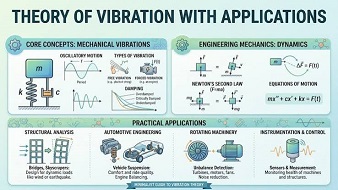
Advanced Dynamics and Vibrations is a higher-level mechanical engineering field
focused on how structures, machines, vehicles, robots, and aerospace systems move,
oscillate, respond to forces, and maintain stability.
1. Advanced Dynamics:
Nonlinear dynamics — motion with nonlinear forces and constraints,
Lagrangian and Hamiltonian mechanics, Rigid-body dynamics, Multibody dynamics,
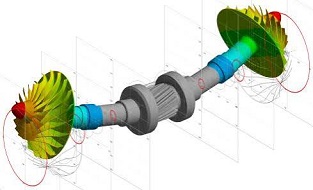
Gyroscopic systems, Rotordynamics, Impact and contact dynamics,
Dynamics of mechanisms and robotic systems, Vehicle dynamics,
Aerospace and spacecraft dynamics, Fluid–structure interaction,
Dynamics of flexible structures.
2. Advanced Vibrations:
Single-degree-of-freedom (SDOF) systems, Multi-degree-of-freedom (MDOF) systems,
Natural frequencies and mode shapes, Free and forced vibration,
Damping and energy dissipation, Modal analysis, Random vibrations,
Nonlinear vibrations, Parametric excitation, Self-excited vibrations,
Vibration isolation, Dynamic absorbers, Structural vibration and fatigue.
3. Mathematical & Computational Methods:
Differential equations, Eigenvalue and eigenvector analysis,
Fourier and Laplace transforms, State-space methods,
Numerical integration, Finite Element Analysis (FEA),
Computational dynamics, Modal reduction, Time-frequency analysis.
4. Important Advanced Phenomena:
Resonance: Large vibration amplitudes can occur when excitation
approaches a system's natural frequency.
Nonlinear behavior: Stiffness, damping, geometry, or contact can make
vibration amplitude and frequency dependent on the motion itself.
Chaos: Some nonlinear mechanical systems can exhibit highly sensitive,
seemingly unpredictable behavior despite being deterministic.
Flutter: An aeroelastic instability involving interaction between
aerodynamic forces and structural dynamics.
Vibration-induced fatigue: Repeated dynamic loading can cause
progressive damage and eventual structural failure.
5. Modern Applications:
🚗 Electric vehicles and autonomous vehicles, 🤖 Robotics and humanoid robots,
✈️ Aircraft and spacecraft, 🚀 Launch vehicles,
⚙️ Turbines, compressors, and rotating machinery,
🏭 Industrial machinery, 🏗️ Bridges and large structures,
🛩️ Drones and UAVs, 🔋 Battery-pack structural dynamics,
🧠 MEMS and microsystems.
6. Advanced Topics to Study: A strong learning sequence is:
Classical Dynamics → Analytical Mechanics → Linear Vibrations → Modal Analysis →
Nonlinear Dynamics → Nonlinear Vibrations → Multibody Dynamics → Rotordynamics →
Random Vibrations → Structural Dynamics → FEA → Fluid–Structure Interaction →
Active Vibration Control.
For modern engineering, combining Advanced Dynamics + Vibrations + FEA +
control systems + AI/ML is particularly useful for predictive maintenance,
digital twins, robotics, and intelligent structural monitoring.
Wishing you all the best,
http://www.seeyourneeds.in