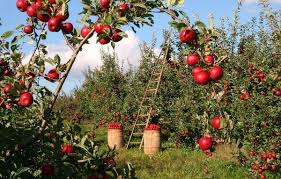
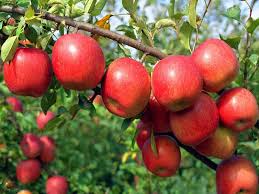
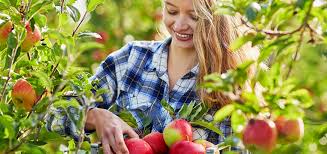
Apple Fruit Farming and Cultivation: Apple is an important fruit in Commercial trading.
And it ranks fourth in the most widely produced fruits in the World after the banana, orange, and grape.
Commercial apple Farming is hugely profitable. However, it demands substantial initial capital investment,
you must have a large area of land for an apple orchard. A 10 acre is a considerable size to have a small-size apple farm.
Malus Domestica: The scientific name of the apple. This is a deciduous
fruit tree in the rose family. Major apple producing countries are China, USA, Poland, Turkey, Iran, Italy, France,
and India. In India, major apple producing states are Arunachal Pradesh, Himachal Pradesh, Jammu & Kashmir.
In this article, we put information about Commercial apple Farming methods and techniques for your ready reference.
Health Benefits Of Apples: First of all, biting
and chewing an apple stimulates the production of saliva in your mouth. Thus, it reduces
tooth decay by lowering the levels of bacteria. The consumption of flavonol-rich apples
helps to reduce your risk of developing pancreatic cancer by up to 23%. Apples help
to reduce your risk for diabetes. The soluble fibres in the apples help to reduce
cholesterol. Red apples contain an antioxidant called quercetin. The quercetin can
help boost your immune system. We can catch a popular statement “One apple a day,
keeps doctors away.”
Things To Consider In Commercial Apple Farming:
Ensure that the Soil is amenable to apple production. Choosing appropriate Varieties
for the local climate is crucial, Ensure proper fruit thinning and harvesting techniques.
You must adopt proper plant protection system, Ensure a proper Irrigation system for your
apple farm.
Best Varieties For Apple Cultivation:
There are almost 7500 apple Varieties Worldwide. Some of the popular Varieties in
the USA are Golden Delicious, Cortland, Haralred, Honeycrisp etc. In addition,
there are some popular Varieties in India. They are M 9, M 26, M7, MM 106, MM 11,
Prima, Priscilla, Sir Prize, Jonafree, Florina, Macfree, Nova Easy Grow, Coop 12,
Coop 13 etc.
Hybrid Varieties: There are some popular hybrid
Varieties. They are Lal Ambri (Red Delicious x Ambri), Chaubattia Princess, Sunehari
(Ambri x Golden Delicious), Chaubattia Anupam (Early Shanburry x Red Delicious), Ambrich
(Richared x Ambri), Ambred (Red Delicious x Ambri), Ambroyal (Starking Delicious x Ambri)
etc.
Agro Climatic Condition For Apple Farming:
In areas with shorter growing seasons, apples that require long growing seasons
to ripen are not appropriate. In areas with the shortest season, summer ripening
apples may be the only option. Dry temperate areas are suitable for apple cultivation.
Temperature: You will need to have a temperature
during the growing season is around 21-240 C. For optimum growth and fruiting, apple
trees need 100-125 cm. of annual rainfall. Excessive rains and fog near the fruit
maturity period result in poor fruit quality with improper colour development. It may
occur fungal spots on its surface. Areas exposed to the high velocity of winds are
not desirable for apple cultivation.
Suitable Soil For Apple Farming:
You can grow apple trees in a wide range of Soils from medium textured clays to gravelly
sands. Loamy Soils, rich in organic matter with pH 5.5 to 6.5 are suitable for apple
Farming. In addition, the Soil must have a proper drainage and aeration. Apples prefer
a slightly acidic to neutral Soil. Extreme Soil pH values result in nutrient tie-up or
toxicity and poor tree and fruit development. It is important to amend the pH in
acidic Soils by incorporating lime before Planting.
Apple Farming Basic Steps: Soil Preparation:
Proper layout and Soil preparation are very essential in establishing a new apple orchard.
Ease of harvesting and management are also key factors you must take into account. Modern
systems use higher densities. And normal densities ranges from 400-2,500 trees/acre.
Planting:
You can adopt square or hexagonal system of Planting. Dig the Planting hole two to
three times wider than the root system of the tree and deep enough to just meet the
root collar. You can mix compost into the back-fill Soil.
In which season does Apple grow:
Apples grow best where there is cold in winter, moderate summer temperatures,
and medium to high humidity. There are apples for fresh eating, some for cooking,
and some for preserving. Some apples are sweet and some are tart. Some apples come
to harvest in summer, some in autumn.
Irrigation:
You must irrigate young trees every 4 – 10 days based on your Soil type and temperatures.
Mature trees need deep watering about every 2 weeks during the growing season so that
moisture reaches a depth of 2-3 feet. This deep Irrigation encourages a well establish
deep rooted tree.
Training & Pruning: Pruning a young tree controls
its shape by developing a strong, well-balanced framework of scaffold branches. Proper
pruning of weak and undesirable branches/twigs is necessary after six years of plantation.
Furthermore, you must remove unwanted branches.
Do apple trees have apples every year:
Many species of apple tree will produce fruit every year -- provided they're grown
in the right conditions and don't sustain any damage. In some situations, your
tree may fall into producing fruit only every second year.
Manuring: Some Varieties of apple trees are also
naturally faster growing and may require no fertilizer to maintain acceptable growth
and fruit production. Retest Soil every 3-4 years to determine what nutrients
(if any) you will need to apply to the Soil.
Weed Control: Frequent hand pulling and shallow
cultivation, no deeper than an inch, controls weeds and minimally disturbs roots.
Deeper cultivation disrupts shallow roots and is not recommended for young,
establishing trees.
Wishing you all the best,
http://www.seeyourneeds.in