What is Blockchain?
**Blockchain** is a decentralized digital ledger technology that records transactions securely
across multiple computers. Instead of storing data in one central server, blockchain distributes
copies of the ledger to many participants in a network.
Each group of records is stored in a **block**, and blocks are linked together using cryptography to form a **chain**.
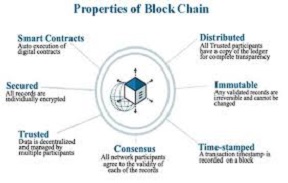
Key Features of Blockchain:
1. Decentralization: No single authority controls the system. Data is shared across many nodes (computers).
2. Transparency: All participants can view transactions recorded on the blockchain.
3. Security: Blockchain uses cryptographic hashing to protect data from tampering.
4. Immutability: Once information is added, it becomes extremely difficult to modify or delete.
5. Consensus Mechanism: Network participants agree on transaction validity through mechanisms like:
* Proof of Work (PoW), * Proof of Stake (PoS)
How Blockchain Works
1. A transaction is initiated. 2. The transaction is broadcast to the network.
3. Nodes validate the transaction. 4. Valid transactions are grouped into a block.
5. The block is added to the chain. 6. The ledger updates across the network.
Simple Structure
Types of Blockchain
Public Blockchain
Open to everyone.
Examples: * Bitcoin, * Ethereum
Private Blockchain: Controlled by a single organization.
Consortium Blockchain: Managed by a group of organizations.
Hybrid Blockchain: Combination of public and private systems.
Important Components: Blocks
Contain: * Transaction data, * Timestamp, * Previous block hash, * Current hash
Hashing: A cryptographic function that converts data into fixed-length codes.
Smart Contracts: Self-executing digital agreements.
Nodes: Computers participating in the blockchain network.
Applications of Blockchain
Finance: * Digital payments, * Cross-border transactions, * Decentralized finance (DeFi)
Supply Chain: Track goods from manufacturing to delivery.
Healthcare: Secure medical record management.
Voting Systems: Transparent and tamper-resistant elections.
Cybersecurity: Secure identity verification and data protection.
NFTs and Digital Assets: Ownership verification for digital content.
Advantages: * High security, * Reduced fraud, * Faster transactions, * Better transparency,
* Lower operational costs, * No central authority dependency
Future of Blockchain: Blockchain technology is expected to play a major role in:
* Web3 ecosystems, * Digital identity systems, * Central Bank Digital Currencies (CBDCs)
* Secure IoT networks, * AI and blockchain integration, * Decentralized applications (dApps)
Conclusion: Blockchain technology provides a secure, transparent, and decentralized way to store and transfer information.
It is transforming industries such as finance, healthcare, logistics, cybersecurity, and digital ownership.
As adoption grows, blockchain is becoming one of the foundational technologies of the digital economy.
Wishing you all the best,
http://www.seeyourneeds.in