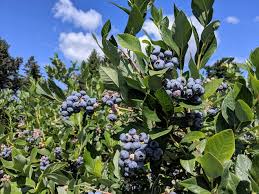
The Space, Soil and Water Requirements and Economics:
In the United States, Blueberries are considered the second most important cultivated berry
after strawberries. Once established Blueberries Plants can be productive for 25 years.
To start a Blueberries farm you must take a long-term view. Blueberries take about 7 years
to reach full maturity and production.
Growth: It can be rewarding in the long run. You can
start getting some limited production the third year of growth. The amount of production
will depend on the varieties selected. You will probably not see significant Blueberries
production until about the fourth year of growth.
Season: Plant early, mid-season and late season ripening varieties to extend
your time to harvest and sell Blueberries. Give them plenty of space in between for air circulation by pruning
them as needed. Some varieties lend themselves better to machine harvest than others, choose varieties that ripening
pretty much the same time for machine harvesting.
Space, Soil and Water Requirements:
Well drained Soil rich in organic material is a necessity for good Blueberries production. Before starting
growing Blueberries it is essential that you have your Soil tested by the local extension service to learn
what amendments may be required. The Soil for example must have a pH between 4.6 and 5.1. Blueberries Plants
will not grow adequately unless the pH requirements of the Soil are met.
Blueberries require: Soils with good drainage and
high organic matter. These two requirements can be met by adding organic matter to the
Soil and using raised beds to make sure there is good drainage. It is best to plant more
than one cultivar to ensure good pollination and a continuous harvest of berries.
Machinery Needed: Fixed machinery needed includes
sprayers, rotary mowers, wagons, tractors, hedgers, trucks, spreaders, mulchers, harrows
and rotary tiller.
Plant Selection and Purchases: Usually two-year-old
potted or bare-root Plants are sold by nurseries are your best purchase. Older Plants
may give you a harvest sooner, but they are generally not cost-effective because of their
added expense and can be harder to establish.
Younger Plants: Must be grown in pots under nursery
conditions before they can survive planting in the field, so again are not usually
cost-effective. You want to grow varieties that will make good profit. Bluecrop,
and blueray are two northern varieties that many use as their main Plants. Bluegold
is also a popular plant.
Where is the best place to plant Blueberries bushes:
It's best to grow Blueberries in an area where water is readily available so
you can keep their roots moist throughout the growing season. Raised beds or patio
containers are good options for planting Blueberries in areas where the soil is
not ideal. Soil preparation is crucial to the health of Blueberries plants.
How much space does a Blueberries bush need:
Spacing. Blueberries can be planted as close as 2 - 2½ feet apart to form solid
hedgerows or spaced up to 6 feet apart and grown individually. If planted in rows,
allow 8 to 10 feet between the rows depending on equipment used for mowing or
cultivating.
What is the best climate to grow Blueberries:
Blueberries are typically grown in humid, northern climates that have winter chills,
mild summers and low-pH or acidic soils, conditions that limit their range. But many
new varieties are available for lower chill areas, very warm areas, as well as
coastal areas.
Harvesting: The three primary methods of harvesting
are: 1) u-pick, 2) Farm hand picking and 3) machine picking. A u-pick or farm hand
picking is most practical when first starting out with only a small number of Blueberries
Plants. It generally requires at least 10 acres of Blueberries before machine
picking is cost effective.
Where do Blueberries grow best: Blueberries growing regions.
Blueberries bushes can pop up all over the U.S., and while 38 states grow Blueberries
commercially, ten states account for more than 98% of U.S. commercial production:
California, Florida, Georgia, Indiana, Michigan, Mississippi, New Jersey, North Carolina,
Oregon and Washington.
Which berry is easiest to grow:
Top ten easy to grow fruit trees and plants. Strawberries. Everybody loves the fresh,
juicy flavour of sun warmed strawberries picked straight from the garden.
Raspberries. Blueberries. Figs. Gooseberries. Apples. Blackberries. Honeyberries.
What should I plant next to Blueberries:
Annual vegetables that can accompany Blueberries include radishes (Raphanus spp.),
potatoes (solanum spp.), peppers (Capsicum spp.) or endive (Cichorium spp.),
while the herb parsley (Petroselinum spp.) makes a decorative and useful companion
to Blueberries as well.
What is the best fertilizer for Blueberries:
Blackberries respond well to any nitrogen-rich fertilizer, but Blueberries
require fertilizers with an ammonium form of nitrogen such as urea, sulfur-coated urea,
ammonium sulfate, or cottonseed meal. Any fertilizer sold for azaleas or rhododendrons
also works well for Blueberries.
Is Epsom salt good for Blueberries bushes:
If your Blueberries need magnesium, Epsom salt grants temporary relief. In deficient soils,
broadcast 1/4 cup of Epsom salt in a 10-inch diameter around the plant, and water
thoroughly. If high pH is the real culprit, extra magnesium in the soil won't help,
and Epsom salt's sulfur doesn't affect pH.
Where do berries grow best: Growing Berries.
Blackberries make good additions to the home garden. Raspberries are best adapted to the cool
coastal climates of California, where they grow in full sun.
Strawberries are a delicious and easy crop to grow in the home garden.
Blueberries belong to the family Ericaceae, which include azaleas and rhododendrons.
Wishing you all the best,
http://www.seeyourneeds.in