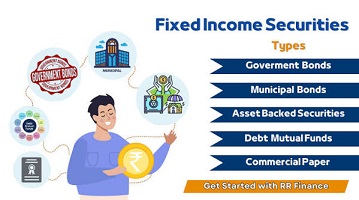
Bonds and fixed-income investments are investments designed to provide relatively
predictable income through interest payments and the return of principal at maturity.
They can play an important role in portfolio diversification, capital preservation,
and generating regular cash flow.
1. What are Bonds: A bond is essentially a loan made by an investor to a government, company,
or other issuer. In return, the issuer generally promises to: Pay periodic interest (coupon):
Return the original investment (principal) at maturity Follow specified terms and conditions.
2. Major Types of Fixed-Income Investments:
Treasury Bills Government: Short-term maturity.
Corporate Bonds Companies: Higher potential yield.
Government Securities (G-Secs) Government: Long-term fixed-income.
State Development Loans State Governments: State-issued securities.
Tax-Free Bonds Certain government entities: Potential tax advantages.
Floating-Rate Bonds: Government/companies: Interest can change.
Bank Fixed Deposits: Banks: Predetermined interest.
Bonds/Notes: Various issuers: Regular interest + principal repayment.
Debt Mutual Funds: Fund houses: Diversified bond portfolios.
Bond ETFs: Fund houses: Exchange-traded bond exposure.
3. How Investors Make Money: There are two main potential sources of return:
Interest income: You receive periodic coupon payments.
Capital gains/losses: If you sell a bond before maturity, its market price
may be higher or lower than what you paid.
For example, if you purchase a ₹1,00,000 bond paying 8% annually, the coupon
income would be approximately ₹8,000 per year, assuming the coupon is calculated
on the full face value and payments are annual.
4. Key Risks: Fixed income does not mean risk-free.
Interest-rate risk: Bond prices generally fall when market interest rates rise.
Credit/default risk: The issuer may fail to make payments.
Inflation risk: Inflation can reduce the real purchasing power of interest income.
Liquidity risk: Some bonds can be difficult to sell quickly.
Reinvestment risk: Future interest rates may be lower when coupons are reinvested.
Call/prepayment risk: Some issuers can repay bonds early under specified conditions.
5. Important Bond Metrics: When evaluating a bond, look beyond the coupon rate.
Yield to Maturity (YTM) – An estimate of the annualized return if the bond is held until maturity,
assuming payments are made as expected and coupons are reinvested according to the calculation.
Credit Rating – Indicates the rating agency's assessment of the issuer's creditworthiness.
Higher-rated bonds generally have lower credit risk but may offer lower yields.
Duration – Measures sensitivity to changes in interest rates. Longer-duration bonds
generally experience larger price movements when rates change.
Maturity – The date on which the principal is scheduled to be repaid.
6. Role in a Portfolio: Fixed-income investments can be used to:
Generate relatively predictable income, Reduce overall portfolio volatility,
Preserve capital, Diversify equity investments, Fund future financial goals,
Create a ladder of maturities, Provide liquidity for planned expenses.
A bond ladder involves purchasing bonds with different maturity dates.
As each bond matures, the principal can be reinvested or used for expenses.
7. What to Check Before Investing: Before purchasing a bond, examine:
Issuer quality, Credit rating, YTM rather than just coupon rate,
Maturity period, Duration/interest-rate sensitivity,
Liquidity and trading volume, Secured vs. unsecured status,
Call or early-redemption provisions, Tax treatment,
Whether the return adequately compensates for the risks, Bottom Line.
Wishing you all the best,
http://www.seeyourneeds.in