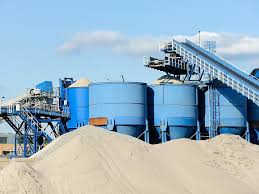
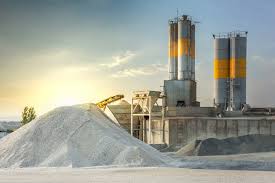
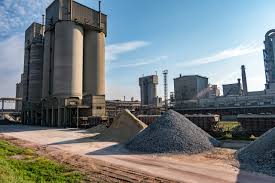
Cement Manufacturing:
Cement manufacturing is a complex process that begins with mining and
then grinding raw materials that include limestone and clay, to a fine
powder, called raw meal, which is then heated to a sintering temperature
as high as 1450 °C in a cement kiln. Cement Manufacturing is also construction
related business but it is a capital intensive.
Sell Cement Competitive Price:
You can sell cement at competitive price because of the massive construction works
that is going on. Before starting this, you should have a project plan with
comfortable capital of your own.
Summary of production process: Cement is
made from limestone and clay. Raw materials are extracted from the quarry crushed
to powder and then blended in the correct proportions.
Blended Raw Material:
This blended raw material is called the 'raw feed' or 'kiln feed' and is heated
in a rotary kiln at a temperature of about 1500 C. The rotary kiln is a tube up
to 200 metres long and perhaps 6 metres in diameter, with a long flame at one end.
The raw feed enters the kiln at the cool end and gradually passes down to the hot
end, then falls out of the kiln and cools down.
Clinker Store:
The material formed in the kiln is described as 'clinker' and is typically composed
of rounded nodules between 1mm and 25mm across. After cooling, the clinker may be
stored temporarily in a clinker store, or it may pass directly to the cement mill.
The cement mill grinds the clinker to a fine powder. A small amount of gypsum -
a form of calcium sulfate - is normally ground up with the clinker. The gypsum
controls the setting properties of the cement when water is added.
What are the raw materials of cement:
The most important raw materials for making cement are limestone, clay
and marl. These are extracted from quarries by blasting or by ripping
using heavy machinery.
How cement is manufactured by dry process:
In dry and semi dry processes for manufacturing of cement, the raw materials
are crushed and fed in the correct proportions into a grinding mill. The raw
materials are dried and reduced in size to a fine powder in to grinding mill.
The dry powder is called the raw meal. The raw meal is pumped into
a blending silo.
Basic raw material for cement industry:
Limestone comprises 95% of core raw material for cement production.
Cement manufacturing consumes minerals such as gypsum, Quartz, bauxite,
coal, kaolin (china clay) and iron ore too in varying amounts.
What are the two methods of manufacture of cement:
From the limestone quarry to the delivery of the end product,
follow every step in the cement manufacturing process.
Step 1: Mining. Step 2: Crushing, stacking, and reclaiming of raw materials.
Step 3: Raw meal drying, grinding, and homogenization.
Step 4: Clinkerization. Step 5: Cement grinding and storage.
Step 6: Packing.
What is mini cement plant:
Mini cement plant is a new cement plant, also known as a small cement plant,
which refers to the cement plant with a clinker capacity of 50-500tpd.
Which process is the best for manufacturing of cement:
Why Choose Dry Process From Manufacturing Cement Methods. Dry process cement
kiln is a kind of rotary kiln which is mainly used in calcining cement
clinker. The cement clinker made by the dry process has better quality
and stability. It can bring more economical and social benefits in production.
What is the basic input in cement industry:
Cement Sector - Industry Inputs. It is the main raw material required for
production of cement. About 1.5 tonnes of limestone is used in the manufacture
of 1 tonne of cement. Cement grade limestone is located only in certain areas
in the country leading to establishment of cement plants in clusters.
What is natural cement:
Natural cement is hydraulic cement made from limestone that has a high clay
content (argillaceous limestone). The resulting powder is natural cement,
which will set when mixed with water, and hardens through a process of
cement hydration.
Wishing you all the best,
http://www.seeyourneeds.in