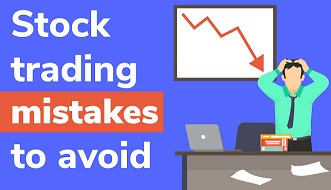
Avoid Common Mistakes in Stock Trading
Good trading is not about avoiding every losing trade—it is about controlling
risk and avoiding preventable errors.
Trading without a plan – Decide your entry, target, stop-loss,
and position size before entering.
No stop-loss – A small planned loss can become a large loss if you keep
hoping for a reversal.
Risking too much on one trade – Avoid concentrating your capital
in a single position.
Overtrading – More trades do not automatically mean more profits.
Trade only when your setup meets your rules.
FOMO buying – Don't chase a stock simply because it has already risen sharply.
Revenge trading – Don't increase your risk just to recover a previous loss.
Ignoring trading costs and taxes – Brokerage, STT, exchange charges,
GST and applicable taxes can reduce returns.
Following tips blindly – Understand the company, valuation, price action,
liquidity and risks yourself.
Using excessive leverage – Leverage can magnify both profits and losses.
Averaging down automatically – A falling price does not necessarily mean
a stock is becoming cheaper in fundamental terms.
Ignoring liquidity – Low-volume stocks can have wide spreads and
may be difficult to exit.
Letting emotions control decisions – Fear, greed and impatience can cause
you to abandon your trading rules.
Not keeping a trading journal – Record the reason for each trade, entry,
exit, profit/loss and mistake.
Changing strategies too frequently – Give a clearly defined strategy
enough trades to evaluate its performance.
Trading money you cannot afford to lose – Keep essential savings and emergency
funds separate from trading capital.
Simple pre-trade checklist:
Before every trade, ask: Why am I entering? → Where is my stop-loss? →
What is my target? → How much can I lose? → What will make me exit?
If you cannot answer these questions clearly, skip the trade.
A useful next step is to learn position sizing + risk/reward ratio + stop-loss
placement together, because these three concepts form the core of risk-controlled trading.
Wishing you all the best,
http://www.seeyourneeds.in