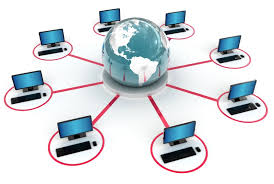
Computing & Communications: Computing and communications technologies form the backbone of the modern digital world.
They enable devices, systems, and people to process, store, and exchange information rapidly across local and global networks.
1. What is Computing: Computing refers to the use of computers and digital systems to process data,
solve problems, automate tasks, and manage information.
Main Components of Computing:
* **Hardware** – Physical devices such as CPUs, memory, storage, and peripherals.
* **Software** – Programs and operating systems that run on hardware,
* **Data** – Information processed by computers,
* **Networks** – Systems that connect computers for communication.
* **Users** – People interacting with computing systems.
2. Types of Computing: Personal Computing.
Computers used by individuals: * Desktops, * Laptops, * Tablets, * Smartphones.
Cloud Computing: Delivery of computing services over the internet.
Service Models: * **IaaS** – Infrastructure as a Service, * **PaaS** – Platform as a Service, * **SaaS** – Software as a Service.
Benefits: * Scalability, * Cost efficiency, * Remote accessibility, * Data backup and recovery.
Examples include services from Amazon Web Services, Microsoft Azure, and Google Cloud.
Edge Computing: Data processing occurs near the source of data generation rather than in centralized servers.
Advantages: * Reduced latency, * Faster response time, * Improved real-time processing, * Lower bandwidth usage.
Used in: * Autonomous vehicles, * Smart factories, * IoT systems.
High-Performance Computing (HPC): Uses supercomputers and clusters for complex calculations.
Applications: * Weather forecasting, * Scientific simulations, * Space research, * Genomics.
3. Communication Technologies: Communication technologies enable transmission of data between devices and systems.
Types of Communication: Wired Communication: * Ethernet, * Fiber optics, * USB communication.
Wireless Communication: * Wi-Fi, * Bluetooth, * Cellular networks, * Satellite communication.
4. Computer Networks: A network connects multiple devices for data sharing and communication.
Types of Networks:
| Network Type | Description |
| ------------ | ------------------------- |
| LAN | Local Area Network |
| WAN | Wide Area Network |
| MAN | Metropolitan Area Network |
| PAN | Personal Area Network |
5. Internet and Web Technologies:
Internet: A global network connecting billions of devices.
World Wide Web (WWW): A system of webpages accessed through browsers.
Important technologies: * HTTP/HTTPS, * HTML, * CSS, * JavaScript
Popular web browsers include Google Chrome, Mozilla Firefox, and Microsoft Edge.
6. Mobile and Wireless Communication:
Cellular Networks:
Evolution: * 1G → Analog voice, * 2G → Digital communication, * 3G → Internet access,
* 4G → High-speed broadband, * 5G → Ultra-fast low-latency communication.
5G Features: * High bandwidth, * Massive device connectivity, * Low latency, * Smart city support.
7. Internet of Things (IoT): Internet of Things connects physical devices to the internet.
Examples: * Smart homes, * Wearable devices, * Smart agriculture, * Industrial automation.
Components: * Sensors, * Connectivity, * Cloud platforms, * Analytics systems.
8. Artificial Intelligence in Computing: Artificial Intelligence improves automation and intelligent decision-making.
Applications: * Voice assistants, * Recommendation systems, * Autonomous systems, * Fraud detection.
Related fields: * Machine learning, * Deep learning, * Natural language processing.
9. Cybersecurity in Communications: Cybersecurity protects systems and networks from attacks.
Common Threats: * Malware, * Phishing, * Ransomware, * Data breaches.
Security Techniques: * Encryption, * Firewalls, * Multi-factor authentication, * Intrusion detection systems.
Security companies include Cisco, Palo Alto Networks, and CrowdStrike.
12. Advantages: * Faster communication, * Global connectivity, * Improved productivity, * Automation, * Better access to information.
13. Challenges: * Cybersecurity risks, * Privacy concerns, * Digital divide, * High infrastructure cost, * Electronic waste.
Conclusion: Computing and communications technologies are transforming every aspect of society. Advances in cloud computing,
AI, IoT, wireless networks, and cybersecurity continue to create smarter, faster, and more connected systems.
These technologies will remain central to innovation, economic growth, and global communication in the future.