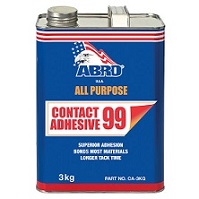
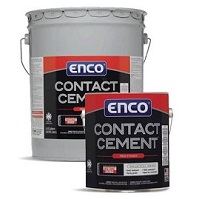
Contact Cement
**Contact cement** is a **high-strength adhesive** that bonds two surfaces instantly
when both surfaces are coated, allowed to dry until tacky, and then pressed together.
Unlike many other adhesives, it requires **no clamping** after assembly because
the bond forms immediately upon contact.
It is widely used in **furniture manufacturing, interior decoration, construction,
automotive upholstery, footwear, and laminate installation**.
How Contact Cement Works: 1. Apply a thin, even coat to **both surfaces**.
2. Allow the adhesive to dry until it becomes tacky (typically **10–30 minutes**, depending on the product).
3. Carefully align the surfaces. 4. Press them together firmly using a roller or hand pressure.
5. The bond is immediate and reaches full strength within **24–72 hours**.
Advantages: * Instant bonding, * No clamping required, * High initial strength, * Flexible after curing,
* Excellent heat resistance (solvent-based grades), * Water-resistant options available,
* Good vibration resistance, * Ideal for large surface areas, * Long-lasting durability,
* Easy brush, roller, or spray application.
Limitations: * Difficult to reposition once joined, * Strong solvent odor (solvent-based types),
* Flammable before curing, * Surface preparation is essential,
* Not suitable for structural load-bearing joints,
* Some formulations are not suitable for continuous water immersion.
Drying and Curing:
| Stage | Typical Time |
| ----------------- | -------------- |
| Open Time | 10–30 minutes |
| Initial Bond | Immediate |
| Handling Strength | Within minutes |
| Full Cure | 24–72 hours |
Times vary depending on temperature, humidity, adhesive type, and material.
Safety Precautions: * Work in a well-ventilated area. * Wear protective gloves and safety glasses.
* Keep away from sparks, flames, and heat sources. * Avoid prolonged skin contact.
* Follow the manufacturer's instructions for storage and disposal.
Storage: * Store in tightly sealed containers. * Keep in a cool, dry place.
* Protect from direct sunlight. * Keep away from ignition sources.
* Observe the product's shelf-life recommendations.
Comparison with Other Adhesives:
| Adhesive | Bond Speed | Flexibility | Gap Filling | Best Applications |
| -------------------------- | ---------- | ----------- | ----------- | --------------------------- |
| Contact Cement | Immediate | High | Low | Laminates, leather, rubber |
| PVA Wood Glue | Slow | Medium | Low | Woodworking |
| Epoxy | Moderate | Low | Excellent | Structural repairs |
| Cyanoacrylate (Super Glue) | Very Fast | Low | Poor | Small, precise repairs |
| Silicone Adhesive | Moderate | Very High | Moderate | Sealing and flexible joints |
Summary: Contact cement is a versatile adhesive designed for **instant, high-strength bonding**
of large surface areas such as laminates, wood, leather, rubber, foam, and metal. Its immediate bond,
flexibility, and durability make it a preferred choice in furniture, construction, automotive,
and footwear industries. Proper surface preparation and accurate alignment are critical because
the bond forms as soon as the coated surfaces come into contact.