Crack Propagation and Stress Intensity
Crack propagation and stress intensity are important topics in Fracture Mechanics,
a branch of mechanical engineering that studies how cracks initiate, grow,
and cause structural failure in materials.
1. What is crack propagation? Crack propagation is the process by which an
existing crack grows through a material under applied loading.
Common causes include:
- Repeated loading and unloading (fatigue).
- Excessive tensile stress.
- Corrosion combined with mechanical stress.
- High temperatures and thermal cycling.
- Material defects and manufacturing imperfections.
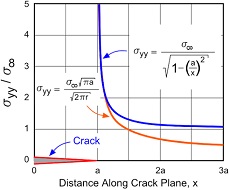
2. What is stress intensity factor? The stress intensity factor (SIF) measures
the intensity of the stress field near a crack tip in a linear-elastic material.
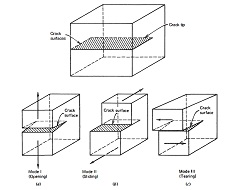
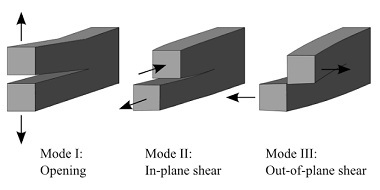
Mode I represents crack opening, where tensile loading pulls the crack faces apart.
Three modes of crack deformation.
Mode I — Opening: Tensile stress pulls the crack faces apart.
This is the most commonly analyzed mode.
Mode II — Sliding: Shear stress causes the crack faces to slide
relative to each other in the crack plane.
Mode III — Tearing: Shear loading displaces the crack faces out of the crack plane.
3. Critical stress intensity factor and fracture toughness:
The fracture toughness, denoted \(K_{IC}\) under valid plane-strain Mode I conditions,
measures a material's resistance to crack extension under linear-elastic fracture mechanics.
When the applied stress intensity reaches the critical value, unstable fracture may occur,
provided the applicable fracture-mechanics conditions are satisfied.
For safe design, engineers generally aim to keep the applied stress intensity below
the appropriate critical value, with a suitable safety margin.
4. Crack propagation rate: Under cyclic loading, fatigue cracks often grow
incrementally with each load cycle.
This law applies primarily to the stable, intermediate region of fatigue crack growth.
It does not accurately describe every stage of crack growth, particularly near
the threshold or final fracture.
5. Engineering applications: Aerospace engineering:
Predicting fatigue crack growth in aircraft fuselages, wings, and turbine components.
Pressure vessels and pipelines: Evaluating flaws in welds and preventing leakage
or catastrophic rupture.
Computational mechanics: Using finite element analysis (FEA) to calculate stress
intensity factors and simulate crack growth.
Wishing you all the best,
http://www.seeyourneeds.in