ETF Investing
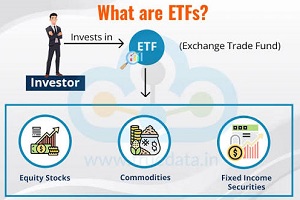
ETF (Exchange-Traded Fund) investing is a simple way to invest in a basket of assets
such as stocks, bonds, gold, or an index—through a single exchange-traded security.
1. How ETFs work: Instead of buying 50 individual stocks, you can buy one ETF that
tracks an index containing those stocks.
Example: ₹10,000 → ETF → dozens/hundreds of underlying securities
ETFs are bought and sold on the stock exchange much like individual shares.
2. Major types of ETFs:
ETF type: What it invests in Typical purpose.
Index ETF: Nifty/Sensex or other indexes Long-term wealth creation.
Large-Cap ETF: Large companies Core portfolio.
Mid-/Small-Cap ETF: Mid/small companies Higher growth potential.
Sector ETF: IT, banking, pharma, etc. Sector exposure.
Gold ETF: Gold Diversification/hedging.
Silver ETF: Silver Commodity diversification.
Bond ETF: Government/corporate bonds Income/stability.
International ETF: Foreign markets Global diversification.
Dividend ETF: Dividend-paying companies Income + potential growth.
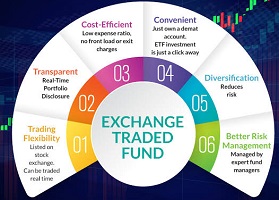
3. Advantages: Diversification: One ETF can contain many securities.
Lower costs: Expense ratios are often lower than actively managed funds.
Liquidity: ETFs can generally be bought and sold during market hours.
Transparency: Holdings and index methodology are usually disclosed.
Convenience: Useful for building a diversified portfolio with relatively few transactions.
Flexible investing: You can invest gradually through periodic purchases.
4. Important risks: ETF does not mean risk-free.
Watch for: Market volatility, Tracking error, Low trading liquidity, Bid–ask spreads,
Sector concentration, Currency risk in international ETFs,
Interest-rate/credit risk in bond ETFs, Commodity-price volatility in gold/silver ETFs.
5. How to select an ETF: Before investing, compare: Expense ratio →
tracking error → AUM → trading volume/liquidity → bid–ask spread →
underlying index → fund history → taxation.
Don't choose an ETF simply because its unit price is ₹20, ₹50, or ₹100.
A low share price does not make an ETF cheaper or better.
6. A simple ETF strategy: For a long-term investor, a possible structure is:
Core, Broad-market index ETF, Diversification, Gold ETF, International ETF,
Optional growth: Mid-cap/small-cap or sector ETF.
Optional stability: Bond ETF, The exact allocation should depend on your time horizon,
risk tolerance, income, and financial goals.
ETF investing principle: Focus on the underlying assets, diversification, costs,
tracking quality, liquidity, and your asset allocation—not the ETF's nominal share price.
If you're investing in India, I can also give you a practical. “ETF Investing in India”
guide covering Nifty ETFs, Gold ETFs, Silver ETFs, international ETFs, dividend ETFs,
low-cost ETFs, and how to build an ETF portfolio.
Wishing you all the best,
http://www.seeyourneeds.in