Epoxies
Epoxies are a class of high-performance thermosetting polymers formed by curing epoxy resins
with hardeners. They are widely used because of their excellent adhesion, mechanical strength,
chemical resistance, and electrical insulation properties.
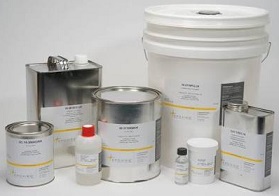
What Are Epoxies: An epoxy system consists of two main components:
Epoxy Resin (Part A): Contains reactive epoxy groups.
Hardener or Curing Agent (Part B): Reacts with the resin to form a rigid, cross-linked polymer.
Once mixed, the chemical reaction is irreversible, producing a durable material.
Key Properties: * Excellent adhesion to metals, concrete, wood, glass, and compositesm
* High mechanical strength and toughness, * Outstanding chemical and solvent resistance,
* Good electrical insulation, * Low shrinkage during curing,
* Excellent moisture resistance, * Good dimensional stability,
* High durability and long service life.
Common Types of Epoxy Resins:
1. Bisphenol A (BPA) Epoxy Resin: * Most widely used, * General industrial applications.
2. Bisphenol F (BPF) Epoxy Resin: * Lower viscosity, * Better chemical resistance.
3. Novolac Epoxy Resin: * Superior heat and chemical resistance, * Used in harsh environments.
4. Aliphatic Epoxy Resin: * Excellent UV resistance, * Suitable for outdoor coatings.
Types of Hardeners: * Amines, * Polyamides, * Anhydrides, * Thiols, * Phenalkamines.
The choice of hardener determines curing speed, flexibility, heat resistance, and chemical resistance.
Advantages: * Very strong adhesive properties, * High durability, * Excellent corrosion protection,
* Resistant to chemicals and water, * Good thermal stability, * Superior electrical insulation,
* Long service life, * Low maintenance.
Limitations: * Can become brittle without modification
* Limited resistance to prolonged UV exposure (unless specially formulated)
* Higher cost than many commodity plastics
* Requires accurate resin-to-hardener mixing ratios
* Difficult to recycle after curing
Comparison with Other Thermosets:
| Property | Epoxy | Polyester | Vinyl Ester |
| ------------------- | --------- | --------- | ----------- |
| Adhesion | Excellent | Good | Very Good |
| Mechanical Strength | Excellent | Good | Very Good |
| Chemical Resistance | Excellent | Moderate | Excellent |
| Water Resistance | Excellent | Good | Excellent |
| Cost | High | Low | Medium |
| Cure Shrinkage | Low | High | Moderate |
Emerging Trends:
* Bio-based epoxy resins from renewable feedstocks,
* Low-VOC and solvent-free formulations, * Toughened epoxies for impact resistance,
* Faster-curing systems for manufacturing, * Recyclable and reworkable epoxy technologies,
* Nanocomposite epoxies with enhanced mechanical and thermal performance.
Epoxies remain one of the most versatile engineering materials, playing a critical role in adhesives,
protective coatings, electronics, construction, and advanced composites due to their exceptional
combination of strength, durability, and chemical resistance.