Fatigue and Failure Analysis
Fatigue and Failure Analysis is a branch of mechanical engineering concerned with understanding
how and why components fail, especially when they experience repeated or fluctuating loads
over time.It is essential in automotive, aerospace, mechanical, civil, manufacturing,
energy, and biomedical engineering.
1. What is Fatigue? Fatigue is the progressive damage and eventual cracking
of a material caused by repeated or cyclic loading, even when the applied stress
is below the material's static strength.
Typical examples: Rotating shafts, Aircraft wings, Engine components, Bridges,
Turbine blades, Gears and bearings, Welded structures.
A typical fatigue process is:
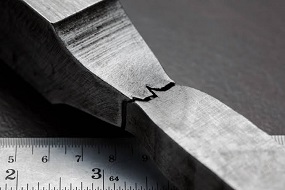
Cyclic loading → Crack initiation → Crack growth → Critical crack size → Sudden fracture.
2. Types of Fatigue: High-Cycle Fatigue (HCF): Large number of cycles, relatively
low stress, Low-Cycle Fatigue (LCF) Fewer cycles, significant plastic deformation,
Thermal Fatigue Repeated temperature changes create cyclic stresses,
Corrosion Fatigue: Fatigue combined with a corrosive environment,
Contact Fatigue Repeated contact stresses, common in gears and bearings,
Vibration Fatigue: Failure caused by continuous or random vibration.
3. Important Fatigue Analysis Methods: S–N Method.
Relates stress amplitude (S) to number of cycles to failure (N).
Commonly used for high-cycle fatigue.
ε–N Method: Relates strain amplitude to fatigue life. Particularly useful for
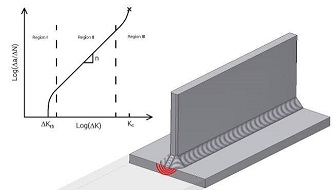
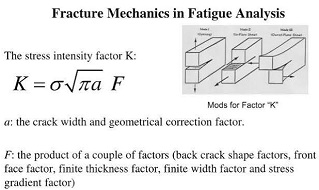
low-cycle fatigue. Fracture Mechanics: Studies existing cracks and their growth.
Uses parameters such as stress intensity factor (K) and energy release rate.
Cumulative Damage Analysis: Used when a component experiences different loading levels.
Miner's Rule is a common approach.
7. Modern Fatigue Analysis:
Engineering teams increasingly combine fatigue analysis with Finite Element Analysis (FEA) and
computational methods: CAD model → FEA → Stress/strain results → Fatigue calculation →
Crack-growth analysis → Predicted.
life Software such as ANSYS, Abaqus, nCode, and MSC Nastran can be used
for advanced fatigue and failure studies.
8. Why It Is Important: Fatigue and failure analysis helps engineers:
Predict component lifetime, Prevent unexpected failures, Improve product safety,
Reduce maintenance costs, Optimize material selection, Improve component geometry,
Establish inspection intervals, Increase reliability, Design for damage tolerance.
Key Concept: Static strength asks: “Will it fail under this load?”
Fatigue analysis asks: “How many cycles can it survive under repeated loading?”
This topic connects closely with Fracture Mechanics, Nonlinear Mechanics,
Computational Mechanics, Advanced Dynamics & Vibrations, Materials Science, and FEA.
Wishing you all the best,
http://www.seeyourneeds.in