Fracture Mechanics
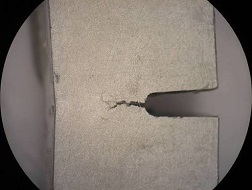
Fracture Mechanics is the branch of mechanical engineering that studies how cracks
and defects develop, grow, and cause failure in materials and structures.
It is especially important when a component contains small cracks that may not be
detected by conventional strength calculations.
1. Why Fracture Mechanics is Important:
Traditional design often assumes a material is free of cracks. In reality,
components can contain:
Manufacturing defects, Fatigue cracks, Weld defects, Corrosion damage,
Inclusions and voids, Stress concentrations, Impact damage.
Fracture mechanics helps engineers determine whether an existing crack
will remain stable or grow to cause failure.
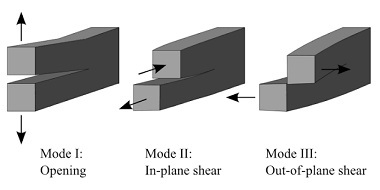
2. Main Types of Fracture:
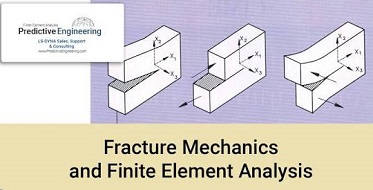
Mode I: Opening or tensile crack, Mode II: In-plane sliding,
Mode III: Out-of-plane tearing, Mixed Mode: Combination of two or more modes.
Mode I is the most commonly studied.
When: $$ K \geq K_{IC} $$, unstable fracture can occur.
Here, \(K_{IC}\) is the material's fracture toughness under plane-strain conditions.
4. Fracture Toughness:
Fracture toughness measures a material's resistance to crack propagation.
For example: High fracture toughness → better resistance to crack growth.
Low fracture toughness → greater susceptibility to sudden fracture.
This is particularly important for aircraft, bridges, pressure vessels,
pipelines, automobiles and heavy machinery.
5. Fatigue Crack Growth: Repeated loading can cause a crack to grow even
when the applied stress is below the material's normal yield strength.
A common relationship is the Paris Law: $$ \frac{da}{dN}=C(\Delta K)^m $$
where: \(a\) = crack size; \(N\) = number of loading cycles; \(C,m\) = material constants;
\(\Delta K\) = range of stress intensity factor.
This allows engineers to estimate remaining fatigue life.
6. Energy-Based Fracture Mechanics:
Another important concept is the energy release rate \(G\).
A crack propagates when the available energy reaches the critical value:
$$ G \geq G_c $$.
This approach is especially useful for:
Composite materials, Adhesives, Laminated structures,
Brittle materials, Important Concepts to Learn.
A strong Fracture Mechanics curriculum includes:
Stress concentration, Crack-tip stresses, Linear Elastic Fracture Mechanics (LEFM),
Stress Intensity Factor \(K\), Fracture toughness \(K_{IC}\),
Energy release rate \(G\), J-integral, Elastic-Plastic Fracture Mechanics (EPFM),
Crack-tip plasticity, Fatigue crack growth, Paris Law, Crack closure,
Critical crack size, Damage tolerance, Failure assessment diagrams,
Mixed-mode fracture, Dynamic fracture, Fracture of composites,
Computational fracture mechanics, Finite Element Analysis (FEA) of cracks.
8. Applications: Fracture Mechanics is widely used in:
✈️ Aerospace engineering, 🚗 Automotive engineering, 🏗️ Civil and structural engineering,
🚢 Marine engineering, ⚡ Power plants, 🛢️ Oil and gas pipelines, 🤖 Robotics,
🏭 Manufacturing, 🔩 Welding and fabrication, 🧱 Composite materials.
9. Fracture Mechanics + Modern Engineering:
Today, Fracture Mechanics is increasingly combined with Computational Mechanics,
FEA, AI/ML, digital twins and advanced materials.
A modern workflow can be:
Material testing → Crack detection → FEA → Stress intensity calculation →
Crack-growth prediction → Remaining-life estimation → Maintenance decision.
This makes Fracture Mechanics an important advanced topic within Computational
Mechanics and Advanced Mechanical Engineering.
Wishing you all the best,
http://www.seeyourneeds.in