Fracture Mechanics and Fatigue Analysis
Fracture Mechanics and Fatigue Analysis are important branches of mechanical engineering
used to understand how cracks develop, how materials fail, and how long components
can operate safely under repeated loading. They are widely used in aerospace, automotive,
manufacturing, power plants, bridges, pressure vessels, and heavy machinery.
1. Fracture Mechanics: Fracture mechanics studies the behavior of cracks in materials
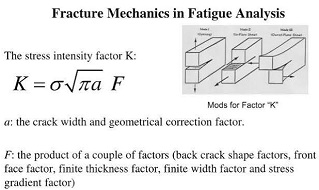
Important equation: For a simple Mode I crack under linear-elastic conditions:
Fracture becomes critical when the stress intensity reaches the applicable fracture
toughness, under the assumptions of the model:
This condition helps engineers assess whether a cracked component may fracture suddenly.
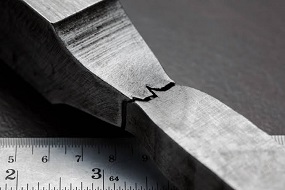
2. Fatigue Analysis: Fatigue analysis studies material damage caused by repeated or
fluctuating loads. A component can fail after many loading cycles, even when the
applied stress is below its yield strength.
Important fatigue equations: A. Stress amplitude:
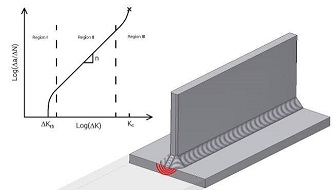
B. Mean stress: C. Paris–Erdogan crack growth law.
Where: The Paris law describes a middle region of stable fatigue crack growth;
it does not fully describe crack initiation, near-threshold growth, or final unstable fracture.
3. Fracture Mechanics vs. Fatigue Analysis:
Main focus: Behavior and failure of cracks, Damage under cyclic loading
Primary concern Crack stability and fracture Crack initiation and life
Typical loading Static, dynamic, or transient Repeated or fluctuating
Key parameter \(K_I\), \(K_{IC}\) Stress amplitude, \(S\)-\(N\) data, \(\Delta K\)
Common methods LEFM, elastic-plastic fracture mechanics S–N, strain-life,
crack-growth methods, Main objective: Assess fracture risk, Estimate fatigue life and prevent failure
4. Engineering software used:
ANSYS Mechanical: Finite element stress analysis, crack-tip evaluation,
fatigue-life estimation, and structural durability studies.
Abaqus: Advanced crack modeling, nonlinear material behavior, fracture simulation,
and fatigue crack-growth studies.
NASGRO: Specialized crack-growth and fracture analysis, particularly for aerospace
and structural integrity applications.
7. Recommended learning path:
1. Fundamentals: Material science, strength of materials, stress and strain.
2. Fracture theory: Crack geometry, stress intensity, and fracture toughness.
3. Fatigue theory: Cyclic loading, S–N curves, mean stress, and fatigue life.
4. Numerical simulation: Learn finite element meshing, boundary conditions, and crack-tip analysis.
5. Practical projects: Analyze a cracked plate, a cyclically loaded shaft,
or an aircraft component using test data and simulation.
Wishing you all the best,
http://www.seeyourneeds.in