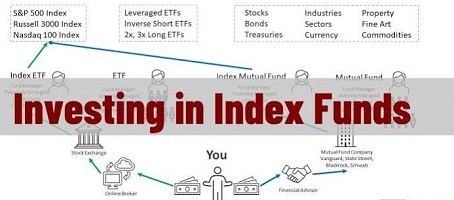
Index Fund Investing
Index fund investing means investing in a fund designed to track a particular
market index rather than trying to select individual stocks.
For example, an index fund tracking the Nifty 50 aims to provide returns broadly
similar to the Nifty 50, minus expenses and tracking differences.
How Index Funds Work: 1. You invest money in an index fund.
2. The fund invests in the securities that make up its target index.
3. Your investment automatically gets exposure to many companies.
4. The fund periodically adjusts its holdings when the underlying index changes.
5. Your returns broadly follow the performance of the index.
Advantages:
| Benefit | Explanation |
| --------------------------- | ------------------------------------------------------------- |
| Diversification | One fund can give exposure to dozens or hundreds of companies |
| Low cost | Passive management generally means lower expenses |
| Simple | No need to research and select individual stocks |
| Transparent | The underlying index and its constituents are generally known |
| Long-term friendly | Well suited to systematic investing |
| Less active-management risk | You aren't depending on a fund manager to pick winning stocks |
Popular Index-Fund Categories in India:
* Nifty 50 Index Funds — large, established Indian companies
* Nifty Next 50 Index Funds — companies immediately below the Nifty 50
* Nifty 100 Index Funds — broader large-cap exposure
* Nifty 500 Index Funds — much broader exposure across the Indian equity market
* Nifty Midcap 150 Index Funds — mid-sized companies
* Nifty Smallcap 250 Index Funds — smaller companies, with substantially higher volatility
* Sectoral Index Funds — focused on sectors such as banking, IT, pharma, etc.
Important Things to Check: Before choosing an index fund, look at:
1. Expense ratio: Lower costs generally help long-term returns.
2. Tracking difference: A fund may not perfectly match its index.
Compare how closely it has tracked the benchmark.
3. AUM and liquidity: Larger, established funds can sometimes
offer better operational efficiency.
4. Index methodology: Understand what companies and sectors the index actually contains.
5. Direct vs Regular plan: For investors managing their investments themselves, Direct plans
generally have lower expenses than Regular plans because they don't include distributor commissions.
6. Risk level: An index fund is not automatically low-risk. A Nifty 50 index fund can fall
substantially during a major market decline, while small-cap or sectoral index funds can be
considerably more volatile.
SIP Strategy: A common approach is to invest a fixed amount every month through a
Systematic Investment Plan (SIP).
For example: ₹10,000/month × 20 years = ₹24 lakh invested
If the investment averaged 12% annually, the final value would be approximately ₹99 lakh.
This is only an illustration—not a guaranteed return.
A Simple Long-Term Approach: For someone seeking simplicity, a portfolio could be structured around:
Core: Nifty 50 / broad-market index fund
↓
Additional diversification: Nifty Next 50 or broader Nifty 500 index
↓
Optional higher-risk allocation: Mid-cap/small-cap index
↓
Debt/emergency reserves: Separate from equity investments
The key principle is low costs + broad diversification + regular investing +
long holding periods + avoiding emotional buying and selling.
For most investors, index investing is less about finding the "best" fund and more
about staying invested consistently and keeping costs and unnecessary complexity under control.
Wishing you all the best,
http://www.seeyourneeds.in