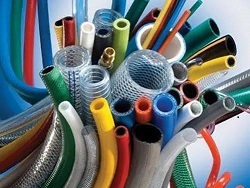
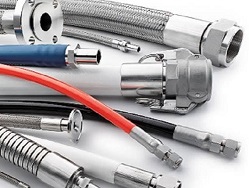
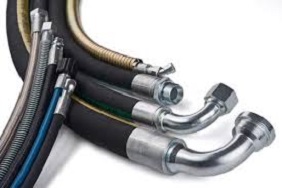
Industrial Hoses
Industrial hoses are flexible tubes designed to safely transport liquids, gases, powders,
slurries, steam, and other materials in industrial environments. They are manufactured from
materials such as rubber, PVC, polyurethane, silicone, thermoplastics, PTFE, and metal,
depending on the application and operating conditions.
Main Components of an Industrial Hose:
1. Inner Tube: * Carries the fluid or material, * Resistant to chemicals, oils, or abrasion.
2. Reinforcement Layer: * Textile braid, * Steel wire braid,
* Steel wire spiral, * Synthetic fiber reinforcement.
3. Outer Cover: * Protects against abrasion, * UV resistance, * Weather resistance,
* Oil and chemical resistance.
Key Performance Parameters: * Working pressure, * Burst pressure, * Vacuum rating, * Temperature range,
* Bend radius, * Abrasion resistance, * Chemical compatibility, * Electrical conductivity,
* Flexibility, * Service life.
Major Industrial Applications: * Oil & gas, * Chemical processing, * Food & beverage, * Pharmaceuticals,
* Mining, * Construction, * Agriculture, * Marine, * Power plants, * Steel plants, * Cement plants,
* Automotive manufacturing, * Paper mills.
Advantages: * High flexibility, * Easy installation, * Excellent pressure handling, * Chemical resistance,
* Abrasion resistance, * Long service life, * Available in numerous sizes and materials,
* Suitable for both low- and high-temperature applications.
Limitations: * Incorrect hose selection can lead to premature failure.
* Some hose materials are incompatible with certain chemicals.
* Hoses require regular inspection and maintenance.
* Exposure to excessive pressure, temperature, or sharp bending can reduce service life.
Selection Factors: When choosing an industrial hose, consider:
* Type of fluid or material being conveyed.
* Operating pressure and vacuum requirements.
* Temperature range, * Chemical compatibility.
* Hose diameter and length.
* Required flexibility and minimum bend radius.
* Environmental exposure (UV, ozone, abrasion).
* Compliance with applicable industry standards.
Common Industry Standards: * ISO standards, * SAE International standards,
* ASTM International standards, * DIN standards, * EN standards,
* FDA regulations (for food-grade hoses).
Future Trends: Advances in industrial hose technology include:
* Smart hoses with embedded sensors for pressure and temperature monitoring
* Lightweight composite constructions
* Improved chemical- and abrasion-resistant materials
* Eco-friendly and recyclable hose materials
* Longer service life with predictive maintenance integration
Industrial hoses are essential components across modern industries, providing safe and efficient
transport of fluids and materials under a wide range of operating conditions. Selecting the correct
hose based on application requirements, operating environment, and industry standards is critical
for ensuring safety, reliability, and long-term performance.
Wishing you all the best,
http://www.seeyourneeds.in