Iron Manufacturing process: Pure iron known to exist naturally comes from fallen meteorites.
Most iron is found in minerals formed by the combination of iron with other elements. Iron oxides are the most common.
Those minerals near the surface of the earth that have the highest iron content are known as iron ores and are mined commercially.
Steel: The most common process is the use of a blast furnace to produce pig iron which is
about 92-94% iron and 3-5% carbon with smaller amounts of other elements. Pig iron has only limited uses, and most of this iron
goes on to a steel mill where it is converted into various steel alloys by further reducing the carbon content and adding other
elements such as manganese and nickel to give the steel specific properties.
Raw Materials: The raw materials used to produce pig iron in a blast furnace are iron ore, coke,
sinter, and limestone. Iron ores are mainly iron oxides and include magnetite, hematite, limonite, and many other rocks.
The iron content of these ores ranges from 70% down to 20% or less. Coke is a substance made by heating coal until it becomes almost pure carbon.
Sinter is made of lesser grade, finely divided iron ore which, is roasted with coke and lime to remove a large amount of
the impurities in the ore. Limestone occurs naturally and is a source of calcium carbonate.Other metals are sometimes
mixed with iron in the production of various forms of steel, such as chromium, nickel, manganese, molybdenum, and tungsten.
The Ore Extraction and Refining Process: Before iron ore can be used in a blast furnace,
it must be extracted from the ground and partially refined to remove most of the impurities.
Extraction: surface of the ground is removed by heavy machines, often over a very large area,
to expose the ore beneath. Shafts are dug into the earth, with side tunnels to follow the layer of ore.
Refining: The mined ore is crushed and sorted. The best grades of ore contain over 60% iron.
Lesser grades are treated, or refined, to remove various contaminants before the ore is shipped to the blast furnace.
The Manufacturing Process: Charging the blast furnace after processing, the ore is blended with other ore and
goes to the blast furnace. A blast furnace is a tower-shaped structure, made of steel, and lined with refractory, or heat-resistant bricks.
The mixture of raw material, or charge, enters at the top of the blast furnace.
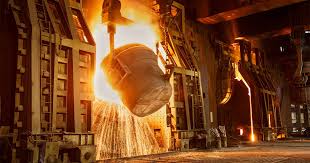
Separating the iron from the slag: The melted iron sinks to the bottom of the furnace.
The limestone combines with the rock and other impurities in the ore to form a slag which is lighter than the iron and floats on top.
As the volume of the charge is reduced, more is continually added at the top of the furnace.
Treating the gases: The hot gases produced in the chemical reactions are drawn off at the top and routed to
a gas cleaning plant where they are cleaned, or scrubbed, and sent back into the furnace; the remaining carbon monoxide,
in particular, is useful to the chemical reactions going on within the furnace.
Quality Control: The blast furnace operation is highly instrumented and is monitored continuously.
Times and temperatures are checked and recorded. The chemical content of the iron ores received from the various mines are checked,
and the ore is blended with other iron ore to achieve the desired charge. Samples are taken from each pour and
checked for chemical content and mechanical properties such as strength and hardness.
Byproducts/Waste: The first and most obvious is the process of open pit mining. Huge tracts of land
are stripped to bare rock. Today, depleted mining sites are commonly used as landfills, then covered over and landscaped.
Some of these landfills themselves become environmental problems, since in the recent past, some were used for the disposal of highly toxic
substances which leached into soil and water.
Wishing you all the best,
http://www.seeyourneeds.in