Lumber:
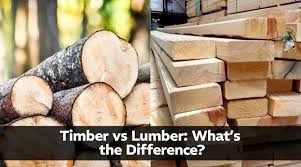
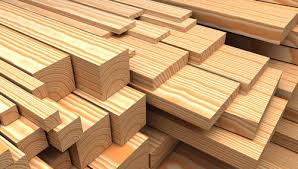
Lumber is a generic term that applies to various lengths of wood used as construction
materials. Pieces of Lumber are cut lengthwise from the trunks of Trees and are
characterized by having generally rectangular or square cross sections, as opposed
to poles or pilings, which have round cross sections.
Lumber produced in early Sawmills:
Had varying dimensions depending on the customers specific order. Lumber pieces used
in construction have standard dimensions and are divided into three categories,
depending on the thickness of the piece.
Pieces of Lumber Surfaced and Machined:
To produce a specific cross sectional shape are classified as worked Lumber or
pattern Lumber. Decorative molding, tongue-and-groove flooring, and shiplap siding
are examples of pattern Lumber.
Raw Materials:
The Trees from which Lumber is produced are classified as hardwoods or softwoods.
During felling, the Trees are cut down with chain Saws and the limbs are removed.
At the mill, the Logs are debarked and bucked, or cut to a predetermined length.
Then they proceed to the bandSaw for further processing.
During felling, the Trees are cut down with Chain Saws:
And the limbs are removed. At the mill, the Logs are debarked and bucked, or cut
to a predetermined length. Then they proceed to the bandSaw for further processing.
Which they shed in the winter. Hardwood Trees include oaks, maples, walnuts, cherries,
and birches, but they also include balsa, which has one of the softest and lightest
of all the woods. Softwood Trees include pines, firs, hemlocks, spruces, and redwoods.
Hardwoods are generally more expensive than Softwoods:
And are used for Flooring, Cabinetry, Paneling, Doors, and Trimwork. They are also
extensively used to manufacture Furniture. Hardwoods are available in lengths
from 4-16 ft (1.2-4.8 m). Softwoods are used for wall Studs, Joists, Planks,
Rafters, Beams, Stringers, Posts, Decking, Sheathing, Subflooring, and Concrete
forms. They are available in lengths from 4-24 ft (1.2-7.3 m).
Defects include Knots, Holes, Pitch Pockets, Splits:
And missing pieces on the Edges or Corners, called Wanes. These defects primarily
affect the appearance, but may also affect the strength of the piece. The higher
Grades are called select Grades. Hardwoods may also be Graded as firsts or seconds,
which are even higher than select. The higher the Grade, the fewer
the number of defects.
The Manufacturing Process:
Here is a typical sequence of operations for processing Trees into Lumber.
Felling:
Selected Trees in an area are visually inspected and marked as being ready to be
cut down, or felled. If a road does not already exist in the area, one is cut and
Graded using bulldozers. If operations are expected to extend into the rainy season,
the road may be graveled, and culverts may be installed across streams
to prevent washouts.
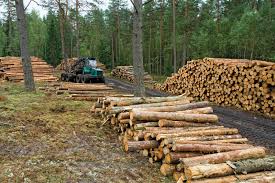
Most Tree felling is done with gasoline Powered Chain Saws:
Two cuts are made near the base, one on each side, to control the direction the
Tree will fall. Once the Tree is down, the limbs are trimmed off with chain Saws,
and the Tree is cut into convenient lengths for transportation.
If the Terrain is relatively level:
Diesel powered tractors, called skidders, are used to drag the fallen Tree sections
to a cleared area for loading. If the terrain is steep, a self-propelled yarder is used.
The yarder has a telescoping hydraulic Tower that can be raised to a height of 110 ft
(33.5 m). Guy wires support the Tower, and cables are run from the top of the Tower
down the steep slopes to retrieve the felled Trees. The Tree sections, or Logs,
are then loaded on trucks using wheeled Log loaders.
Debarking and Bucking:
Logs are picked up from the Log Deck with rubber-tired loaders and are placed on
a chain Conveyor that brings them into the mill. In some cases, the outer bark of
the Log is removed, either with sharp-toothed grinding wheels or with a jet of
high-pressure water, While the Log is slowly rotated about its long Axis. The
removed bark is pulverized and may be used as a fuel for the mill furnaces
or may be sold as a decorative garden mulch.
Grade Stamping and Banding:
Each piece of Lumber is visually or mechanically inspected and Graded according
to the amount of defects present. The Grade is stamped on each piece, along with
information about the moisture content, and a mill identification number. The
Lumber is then bundled according to the type of wood, Grade, and moisture content,
and the bundle is secured with steel bands. The bundle is loaded on a truck or
train and shipped to a Lumber yard for resale to customers.
Quality Control:
There are very few pieces of perfect Lumber. Even though great care is taken to avoid
or minimize defects when Sawing the wood to the required sizes, there are almost
always some defects present. The number and location of these defects determines
the Grade of the Lumber, and the purchaser must choose the Grade that is appropriate
for each specific application.
Wishing you all the best,
http://www.seeyourneeds.in