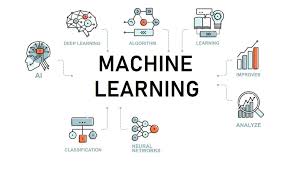
**Machine Learning** is a branch of Artificial Intelligence where computers learn patterns from
data and make decisions or predictions without being explicitly programmed for every task.
Instead of writing fixed rules, ML systems improve automatically through experience (data).
---
Simple Definition: “Machine Learning teaches computers to learn from data.”
Example: Email spam detection, Face recognition, Recommendation systems in Netflix or YouTube,
Voice assistants like Google Assistant and Siri
---
How Machine Learning Works
Basic Steps:
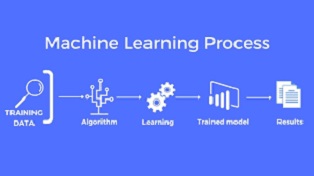
1. **Collect Data** : Images, Text, Numbers, Audio.
2. **Train the Model** : The algorithm studies the data, Finds patterns and relationships
3. **Testing** : * Checks accuracy using new data
4. **Prediction** : * Uses learned knowledge for future decisions
---
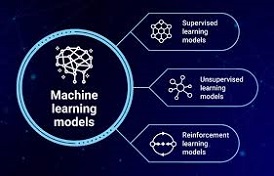
1. Supervised Learning: The model learns using **labeled data**.
Example: * Predicting house prices, Spam email detection.
Common algorithms: * Linear Regression, Decision Trees, Random Forest.
---
2. Unsupervised Learning: The model finds hidden patterns in **unlabeled data**.
Example: * Customer grouping, Market segmentation
Algorithms: * K-Means Clustering, PCA
---
3. Reinforcement Learning: The system learns through **rewards and penalties**.
Example: * Robot navigation, Game-playing AI
Used in: * Self-driving cars, Robotics
---
| Traditional Programming | Machine Learning |
| ----------------------- | --------------------- |
| Rules + Data → Output | Data + Output → Rules |
| Explicit coding | Learns automatically |
| Static | Improves with data |
---
Popular ML Tools & Frameworks: * TensorFlow, * PyTorch, * Scikit-learn, * Apache Spark
---
Programming Languages Used: * Python, * Java, * R, * C++
---
Example: Suppose you want to predict student marks.
Input data: * Study hours, * Attendance, * Previous marks.
The ML model learns patterns and predicts future marks.
---
Future of Machine Learning: Machine Learning is widely used in:
* AI assistants, * Smart healthcare, * Automation, * Robotics, * Finance, * Smart cities
It is one of the most important technologies in modern IT industries.