Molded Components
Molded Components are products manufactured by shaping materials such as plastics, rubber,
silicone, or composites into specific forms using molds. They are widely used across industries
because they offer precision, repeatability, and cost-effective mass production.
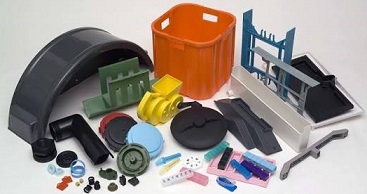
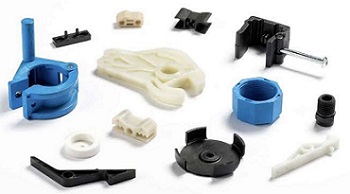
1. Plastic Molded Components: Produced using processes such as injection molding,
blow molding, rotational molding, and thermoforming.
Common Materials: * Polypropylene (PP), * Polyethylene (PE), * Acrylonitrile Butadiene Styrene (ABS),
* Polycarbonate (PC), * Nylon (PA), * Polyoxymethylene (POM).
Applications: * Automotive interiors and exteriors, * Consumer electronics,
* Household products, * Packaging, * Medical devices.
Common Molding Processes:
* Injection Molding – High-volume production of precise plastic parts.
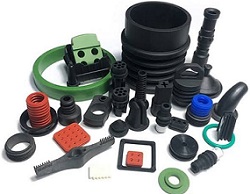
* Compression Molding – Suitable for rubber, composites, and thermoset plastics.
* Transfer Molding – Used for complex rubber and thermoset components.
* Blow Molding – Produces hollow products such as bottles and tanks.
* Rotational Molding – Creates large hollow items like water tanks and playground equipment.
* Thermoforming – Forms heated plastic sheets into desired shapes.
Advantages: * High dimensional accuracy, * Fast production rates, * Consistent quality,
* Low material waste, * Complex shapes can be produced, * Suitable for large-scale manufacturing,
* Wide material selection.
Future Trends: * Lightweight engineering plastics, * Recycled and bio-based polymers,
* Smart molded components with embedded sensors, * High-performance composite molding,
* Increased automation and robotics, * Digital manufacturing and AI-driven quality inspection,
* Sustainable manufacturing with reduced material waste.
Molded components are fundamental to modern manufacturing, enabling the efficient
production of durable, precise, and cost-effective parts for industries ranging
from automotive and healthcare to electronics, construction, and consumer products.
Wishing you all the best,
http://www.seeyourneeds.in