Multibody Dynamics
Multibody Dynamics (MBD) is the study of the motion and interaction of systems
made of multiple interconnected bodies—such as rigid bodies, flexible components,
joints, springs, dampers, and actuators.
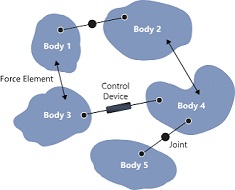
1. Basic idea: A multibody system can contain:
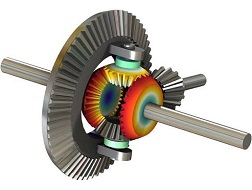
Rigid bodies — links, gears, wheels, shafts,
Flexible bodies — beams, plates, belts, structures,
Joints — revolute, prismatic, spherical, universal joints,
Forces and torques — gravity, friction, motors, external loads,
Springs and dampers, Constraints — relationships that restrict body motion,
The objective is to determine position, velocity, acceleration,
forces, and reactions throughout the system.
2. Important concepts:
Degrees of Freedom: Independent motions available to the system,
Kinematics: Motion without considering forces,
Dynamics: Motion considering forces and torques,
Constraints: Restrictions between bodies,
Joint Forces: Forces transmitted through connections,
Contact Interaction between bodies,
Friction: Resistance between contacting surfaces,
Flexible Multibody Dynamics: Includes deformation of components.
For constrained systems, equations can include Lagrange multipliers:
$$ M(q)\ddot q+\Phi_q^T\lambda=Q $$
where \(\Phi\) represents constraints and \(\lambda\) represents constraint forces.
7. Advanced Multibody Dynamics:
For advanced mechanical engineering, important topics include:
Rigid-body dynamics, Constrained motion, Lagrangian mechanics, Newton–Euler formulation,
Flexible multibody dynamics, Contact and collision dynamics, Friction modeling,
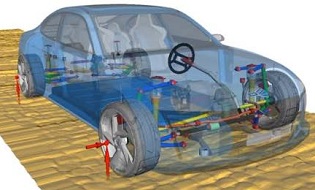
Nonlinear dynamics, Vehicle dynamics, Robot dynamics, Biomechanical systems,
Real-time simulation, Multibody–finite element coupling,
Control of multibody systems, AI/ML-assisted multibody simulation.
In simple terms: Multibody Dynamics answers the question: “How will a complex mechanical system
made of interconnected moving parts move, and what forces will occur inside it?”
Wishing you all the best,
http://www.seeyourneeds.in