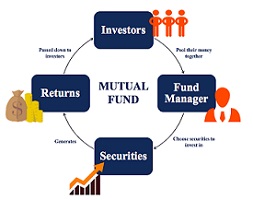
Mutual funds pool money from many investors and invest it in assets such as stocks, bonds,
government securities, gold, or a combination of these. A professional fund manager
manages the portfolio according to the fund's investment objective.
1. Why invest in mutual funds?
Diversification: Your money can be spread across many securities.
Professional management: Fund managers research and manage investments.
SIP convenience: You can invest a fixed amount regularly.
Accessibility: Many funds allow relatively small investments.
Liquidity: Open-ended mutual funds generally allow investors to redeem units,
subject to the fund's rules.
Different risk levels: Options range from relatively conservative debt funds
to aggressive equity funds.
2. Major types of mutual funds:
Type Main investment Typical risk Suitable for
Equity funds Stocks High Long-term wealth creation
Debt funds Bonds/debt securities Low–Moderate* Income/stability
Hybrid funds Equity + debt Moderate Balanced approach
Index funds Market index Moderate–High Low-cost long-term investing
ELSS Equity High Long-term investing + eligible tax benefit
Gold funds/ETFs Gold Moderate–High Diversification
Liquid funds Short-term instruments Low* Short-term parking of money
3. SIP vs lump-sum: SIP: Invest a fixed amount periodically, such as
₹1,000 or ₹5,000 per month. It is useful for disciplined long-term investing and
avoids having to decide when to invest a large amount.
4. How to select a mutual fund:
Don't choose a fund solely because it produced the highest return recently. Consider:
Investment objective, Risk level, Time horizon, Expense ratio,
Portfolio quality and diversification, Fund manager and investment process,
Performance across different market cycles, Benchmark comparison,
Exit load and other costs, Tax treatment, Fund size and liquidity where relevant.
5. Match funds to your goal: Emergency/very short-term needs: Don't take significant equity risk.
3–5 year goals: Consider funds appropriate for your risk tolerance and time horizon.
7–10+ year wealth creation: Diversified equity/index funds can be considered.
Retirement: A diversified portfolio combining suitable equity and fixed-income
investments may be appropriate.
Children's long-term goals: Start early and align asset allocation with the goal date.
6. A simple long-term approach: For a beginner, a simple diversified portfolio is
often easier to maintain than holding many overlapping funds.
7. Common mistakes to avoid:
❌ Chasing last year's top-performing fund, ❌ Buying too many mutual funds,
❌ Selecting funds only because their NAV is low, ❌ Stopping SIPs whenever the market falls,
❌ Ignoring expense ratios and taxes, ❌ Investing emergency money in volatile equity funds,
❌ Choosing a fund without understanding its portfolio,
❌ Expecting guaranteed returns from equity mutual funds.
8. SIP example: Suppose you invest ₹10,000 per month for 20 years.
Total amount invested: ₹10,000 × 12 × 20 = ₹24 lakh
If the investment achieved an illustrative 12% annualized return, the final corpus could be
around ₹99 lakh. This is only a mathematical illustration—not a guaranteed mutual-fund return.
9. Key principle: The best mutual fund is not necessarily the fund with the highest recent
return. The better choice is one whose risk, strategy, costs and expected behavior fit your
financial goal and investment horizon.
Wishing you all the best,
http://www.seeyourneeds.in