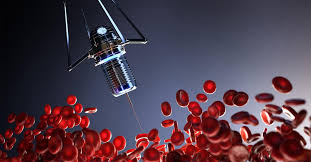
Nanotechnology
Nanotechnology is the science and engineering of materials and devices at the **nanometer scale** (1–100 nanometers).
A nanometer (nm) is one-billionth of a meter: 1\ \text{nm} = 10^{-9}\ \text{meters}
At this tiny scale, materials often show unique physical, chemical, electrical, and biological properties.
What is a Nanomaterial?
A nanomaterial has particles or structures with dimensions in the nanoscale range. Examples include:
* Nanoparticles, * Nanotubes, * Nanowires, * Quantum dots
Types of Nanotechnology
1. Carbon-Based Nanotechnology
Uses carbon materials such as: * Carbon nanotubes, * Graphene, * Fullerenes
Applications: * Electronics, * Batteries, * Strong lightweight materials
2. Nanoelectronics
Development of very small electronic components.
Applications: * Faster processors, * Smaller chips, * Flexible electronics
3. Nanomedicine: Use of nanotechnology in healthcare.
Applications: * Targeted drug delivery, * Cancer treatment, * Medical imaging, * Tissue engineering
4. Molecular Nanotechnology: Manipulation of individual molecules and atoms to create new structures.
Applications of Nanotechnology
Medicine: * Smart drug delivery systems, * Early disease detection, * Artificial organs
Electronics: * Miniaturized circuits, * High-speed computers, * Better memory storage
Energy: * Efficient solar panels, * Advanced batteries, * Hydrogen fuel cells
Environment: * Water purification, * Pollution control, * Waste treatment
Agriculture: * Nano-fertilizers, * Pest detection sensors, * Improved crop protection
Advantages: * Smaller and faster devices, * Improved medical treatments, * Stronger materials
* Energy efficiency, * Reduced waste
Disadvantages: * High production cost, * Possible health risks, * Environmental concerns, * Ethical and privacy issues
Future Scope:
Nanotechnology is expected to play a major role in:
* Artificial Intelligence, * Robotics, * Space technology, * Biotechnology, * Smart materials
Countries like United States, Japan, China, and India are investing heavily in nanotechnology research.
Simple Example: Silver nanoparticles are used in: * Antibacterial coatings, * Medical bandages, * Water filters
because nanosilver can kill bacteria effectively.
Conclusion: Nanotechnology is transforming many industries by enabling the creation of materials and devices at the
atomic and molecular scale. It has enormous potential in medicine, electronics, energy, and environmental protection.