Numerical methods and simulation
Numerical Methods and Simulation is an important area of engineering, applied mathematics,
computer science, and scientific research. It uses mathematical algorithms and computer models
to solve complex problems that are difficult to solve analytically or through physical experiments.
1. What are Numerical Methods?
Numerical methods are mathematical techniques used to find approximate solutions
to mathematical equations using computers.
For example, engineers use numerical methods to calculate stress in a machine component,
predict heat transfer, solve fluid flow equations, and analyze vibrations.
Major numerical methods: 1. Root-Finding Methods, Solve equations to find unknown values.
Examples: Newton–Raphson method, bisection method.
2. Numerical Linear Algebra: Solve large systems of linear equations and matrix problems.
Examples: Gaussian elimination, LU decomposition, iterative solvers.
5. Monte Carlo Methods: Use random sampling to estimate probabilities, uncertainty,
and complex system behavior.
What is Simulation?: Simulation is the process of creating and running a computer-based
model of a real-world system to understand how it behaves under different conditions.
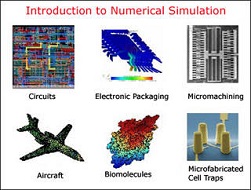
Examples include: Testing a car crash without destroying a real car.
Predicting airflow around an aircraft, Simulating the temperature of an engine.
Studying vibrations in rotating machinery.
Predicting traffic flow or manufacturing performance.
Modeling robots and autonomous systems.
3. Main types of engineering simulation: Finite Element Analysis (FEA)
Divides a structure into small elements to calculate stress, strain,
deformation, and temperature.
Applications: bridges, machine parts, aerospace structures.
Computational Fluid Dynamics (CFD), Simulates liquids and gases, including pressure,
velocity, turbulence, and heat transfer.
Applications: aircraft, turbines, pumps, cooling systems.
Multibody Dynamics Simulation. Models connected bodies, joints, forces, and motion over time.
Applications: robotics, vehicle suspensions, mechanisms. Thermal Simulation.
Predicts temperature distribution, conduction, convection, and thermal expansion.
Applications: engines, batteries, electronics, power plants.
4. Numerical methods vs. simulation: Feature
Numerical methods, Simulation, Main purpose, Solve mathematical problems,
Model system behavior, Input, Equations and numerical data,
Physical model, conditions and parameters, Output, Approximate numerical solution,
Predicted system behavior over space or time, Example, Calculate beam deflection
Simulate the beam under varying loads, Relationship,
Provides computational algorithms, Often uses numerical methods to run models,
Given the mechanical engineering topics you have been exploring, a particularly
useful next step is computational mechanics with Python and the Finite Element Method (FEM).
This combines numerical algorithms with practical stress, deformation, and vibration analysis.
Wishing you all the best,
http://www.seeyourneeds.in