Onion Farming:
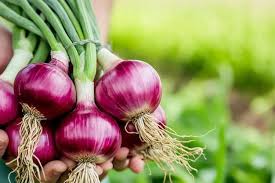
The scientific name of the onion is Allium Cepa. Onion gives a yield of 25 to 30 tonnes/hectare.
Selecting the right variety, proper irrigation system and timely manuring are the most important
factors in the onion farming horticulture business. Globally, China, India and US are the largest producers
of onions. Onion is available throughout the year in India.
Ideal Conditions for Onion Cultivation:
Onion needs a temperate climate and alluvial soil to grow in. Depending on the onion growing
time and place of cultivation, onion can be grown as long day onions or short day onions.
Climate for Onion Farming:
Although it is a temperate crop, onion cultivation can be possible under sub-tropical, temperate or
tropical climate. A mild, gentle weather that is not too rainy, too cold or too hot is ideal for
onion growing. It can withstand extreme weather conditions at younger stage. Short day onions
that need 10-12 hours of day length are grown in plains while long day onions requiring
13-14 hours of day length are grown in the hilly areas.
Other requirements for onion cultivation are: Season for Onion Farming
In India, onions are cultivated both as kharif and rabi crop. This is because onions are
grown in almost all the Indian states. The time and season of onion cultivation depends
on the geographical location and weather at the particular place. Here is a table containing
the time of cultivation and harvesting in different places of cultivation.
pH for Onion Growing:
Soil with neutral pH (6.0 to 7.0) is optimal for onion cultivation. It can tolerate mild alkalinity
(pH upto 7.5). They cannot survive if the soil pH drops below 6.0 owing to aluminum or manganese
toxicity or trace element deficiency.
Water for Growing Onions:
Onion crop irrigation depends on the season of planting, type of soil, irrigation method and
age of the crop. Irrigation is done at the time of seedling plantation, during transplantation
period, 3 days after transplantation and subsequently at regular intervals depending on the
moisture content in soil.
Intercropping in Onion Cultivation:
Onion being shallow-rooted is suitable for intercropping. Two or more crops can be grown together.
It also depends on location, nature of soil and climatic conditions. Idea of inter-cropping
is to use the resources effectively and gain a great yield without causing any harm to the
main crop.
Planting Material for Onion Cultivation:
Since cultivation of onion is influenced by a variety of factors like temperature, photoperiod,
weather, etc. research institutes have developed different varieties suitable for particular
seasons and regions. The commercially grown variety is classified into 3 groups as White,
Yellow and Red.
Land Preparation for Onion Farming:
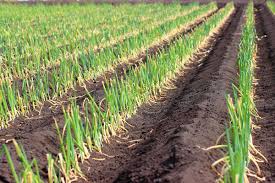
Onion can grow in almost all types of soils. Seeds are sowed in nursery and the seedlings
are transplanted after approximately 30-40 days. Before transplantation the field must be ploughed
properly to get rid of the soil clods and unwanted debris. Vermicomposting or poultry manure can be
incorporated. This is done during the last ploughing.
Seed Preparation:
Seeds are treated with 2g/Kg of thiram or Trichoderma viride to prevent damage from damping
off diseases. The seed distance is maintained at 50-75mm to facilitate easy weeding and removal
of seedlings for transplantation.
Transplantation:
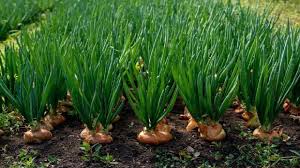
Onion seeds are first grown in nurseries and then the seedlings are transplanted to the fields 30-40
days later. 3-4 Kg seeds are needed for one acre of field. Early transplantation yields more bulbs.
During transplantation, care must be taken to avoid over and under-aged seedlings. The following
process is followed during transplantation.
Onion Harvesting:
Onion harvesting is done when the still green tops start drooping. The plants are gently pulled out
from the soil. However, 10-15 days before harvesting irrigation of the field is stopped. The crop
is also sprayed with 1000 ppm carbendazim 30 days before harvest. This helps increase the shelf-life
of the crop. The bulbs are cleaned and dried in shade for 4 days.
Wishing you all the best,
http://www.seeyourneeds.in