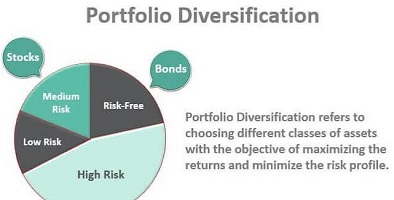
Portfolio diversification means spreading your investments across different assets,
sectors, companies, and geographies so that poor performance in one area does not
severely damage the entire portfolio.
Why diversification matters:
* Reduces concentration risk: Avoids depending heavily on one stock, sector, or asset.
* Improves risk-adjusted returns: Different investments can perform differently
under changing market conditions.
* Protects capital: Losses in one investment may be offset by gains elsewhere.
* Provides stability: A diversified portfolio can generally withstand market volatility better.
* Supports long-term investing: Helps investors remain invested through different market cycles.
The appropriate allocation depends on your risk tolerance, investment horizon,
income, financial goals, and need for liquidity.
Important: diversification ≠ owning many stocks:
Owning 30 stocks from the same sector is not necessarily well diversified. Likewise,
owning several mutual funds that all hold the same companies can create hidden
concentration. A better approach is to diversify across different sources of risk.
Common diversification mistakes:
1. Buying too many overlapping mutual funds or ETFs.
2. Holding too much of one company's stock.
3. Concentrating heavily in small-cap or penny stocks.
4. Ignoring international investments.
5. Diversifying excessively and making the portfolio difficult to manage.
6. Never rebalancing after major market movements.
Rebalancing:
Review the portfolio periodically and bring allocations back toward your target.
For example, if your target is 60% equity and a strong market pushes equity to 70%,
you may rebalance toward the original allocation.
Key principle: Diversification should reduce unnecessary risk, not eliminate
risk or guarantee profits.
Wishing you all the best,
http://www.seeyourneeds.in