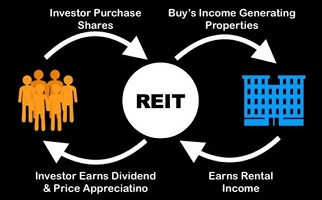
REIT (Real Estate Investment Trust) investing lets you invest in
income-producing real estate without directly buying and managing a property.
How REITs work: A REIT typically owns or finances properties such as:
🏢 Office buildings, 🛍️ Shopping malls, 🏭 Warehouses and logistics parks,
🏨 Hotels, 🏠 Residential properties, 📡 Data centers and telecom infrastructure.
The REIT earns rental or property-related income and distributes
a significant portion of its earnings to investors.
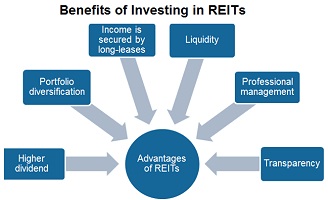
Benefit Explanation:
Regular income Potential distributions from rental/property income.
Low entry cost Buy units instead of purchasing an entire property.
Diversification Add real estate exposure to a stock/bond portfolio.
Liquidity Listed REIT units can generally be bought and sold like shares.
Professional management Properties are managed by the REIT and its operators.
Potential capital appreciation Unit prices can rise as property values and
earnings grow, Risks to understand.
REITs are not risk-free. Important risks include:
Interest-rate increases can pressure REIT valuations.
Falling occupancy or rents can reduce income, Property prices can decline.
Debt levels can increase financial risk, Office and retail REITs
can face structural changes in demand.
Distributions can fluctuate,
Listed REIT prices can be volatile even when the underlying properties change slowly.
REIT investing in India: India has a growing listed REIT market.
Investors can access REITs through the stock exchanges rather
than purchasing physical commercial property.
When evaluating an Indian REIT, look at:
Occupancy rate, Rental income growth, Net Operating Income (NOI),
Debt-to-asset ratio, Interest coverage, Weighted Average Lease Expiry (WALE),
Distribution per unit (DPU), Price-to-NAV, Quality and location of properties,
Tenant concentration, Sponsor/manager quality, Valuation versus other REITs,
REITs vs physical real estate, REIT Physical Property,
Low capital requirement Usually requires large capital,
Easy to buy/sell Difficult to sell quickly,
Professionally managed Owner manages or hires a manager,
Diversified property exposure Often concentrated in one/few properties,
Market-price volatility Property values change more slowly,
A simple strategy: For a long-term investor, REITs can be considered as one component
of a diversified portfolio, rather than replacing stocks, bonds, or other assets.
A useful approach is to focus on high-quality assets, sustainable cash flows,
reasonable debt, strong occupancy and attractive valuation, rather than simply
choosing the REIT with the highest current yield.
Key idea: REIT investing gives you a way to participate in commercial real estate with
much less capital and management responsibility than buying property directly—but you
still take real-estate, interest-rate, business and market risks.
Wishing you all the best,
http://www.seeyourneeds.in