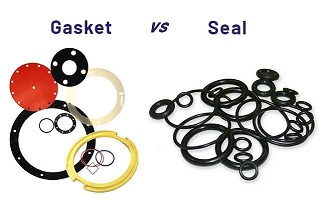
Seals and Gaskets
Seals and gaskets are essential components used to prevent the leakage of liquids, gases, dust,
and contaminants between two surfaces. They play a critical role in industries such as automotive,
aerospace, oil & gas, chemical processing, power generation, construction, and manufacturing.
Types of Seals:
1. O-Ring Seals: * Circular elastomer rings, * Used in hydraulic and pneumatic systems,
* Excellent for static and dynamic sealing, * Low-cost and easy to install.
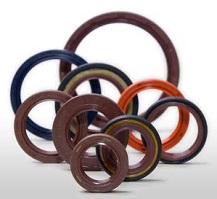
2. Oil Seals (Rotary Shaft Seals): * Prevent lubricant leakage, * Keep dust and dirt out,
* Common in gearboxes, pumps, and engines.
3. Hydraulic Seals: * Used in hydraulic cylinders, * Withstand high pressure,
* Includes piston seals, rod seals, and wipers.
4. Pneumatic Seals: * Designed for compressed air systems,
* Low friction, * High-speed operation.
5. Mechanical Seals: * Used in pumps and compressors,
* Replace traditional packing glands, * Reduce leakage significantly.
6. Lip Seals: * Flexible sealing lip contacts rotating shaft,
* Used in automotive and industrial machinery.
7. U-Cup Seals: * U-shaped profile, * Common in hydraulic cylinders.
8. V-Ring Seals: * Axial shaft seals, * Protect bearings from contamination.
Types of Gaskets:
1. Rubber Gaskets: * Flexible, * Water-resistant,
* Used in plumbing and automotive applications.
2. Compressed Fiber Gaskets: * Oil and chemical resistant,
* Used in industrial pipelines.
3. PTFE Gaskets: * Excellent chemical resistance,
* Non-stick surface, * Suitable for aggressive chemicals.
4. Graphite Gaskets: * High-temperature resistance,
* Steam and refinery applications.
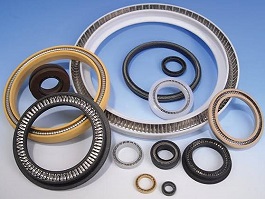
5. Spiral Wound Gaskets: * Metal and filler combination,
* High-pressure and high-temperature service,
* Widely used in refineries and power plants.
6. Metal Ring Gaskets: * Suitable for extreme pressure,
* Used in oil & gas drilling.
7. Cork Gaskets: * Compressible, * Used in engines and transformers.
8. Non-Asbestos Gaskets: * Environmentally safer alternative to asbestos,
* Common in modern industrial applications.
Key Properties: * Leak prevention, * Pressure resistance, * Temperature resistance,
* Chemical compatibility, * Wear and abrasion resistance, * Low compression set,
* Elastic recovery, * Long service life.
Advantages: * Prevent fluid and gas leakage, * Improve equipment reliability,
* Reduce maintenance costs, * Enhance operational safety,
* Increase equipment lifespan, * Resist chemicals and harsh environments,
* Support high-pressure and high-temperature operations.
Limitations: * Material selection is application-specific.
* Improper installation can cause premature failure.
* Some elastomers degrade under UV, ozone, or incompatible chemicals.
* High temperatures or pressures may require specialized materials or metal seals.
Selection Criteria: When selecting a seal or gasket, consider:
* Operating temperature, * Pressure, * Fluid or gas compatibility,
* Static or dynamic application, * Shaft speed (for rotary seals),
* Surface finish, * Compression requirements,
* Regulatory requirements (e.g., food-grade or pharmaceutical standards),
* Service life and maintenance intervals.
Major Manufacturers: Some leading global manufacturers of seals and gaskets include:
* Trelleborg Group, * Freudenberg Sealing Technologies, * Parker Hannifin,
* SKF, * James Walker, * Garlock.
Seals and gaskets are indispensable components across industries, ensuring leak-free operation,
protecting equipment from contamination, and improving safety, efficiency, and durability in systems
ranging from household appliances to heavy industrial machinery.
Wishing you all the best,
http://www.seeyourneeds.in