Structural and Thermal Analysis
Structural and Thermal Analysis is an important branch of mechanical engineering
used to predict how components, machines, buildings, and materials behave under
mechanical loads and temperature changes. It is widely used in aerospace, automotive,
power generation, manufacturing, civil engineering, and advanced product design.
1. Structural Analysis:
Structural analysis determines how a component or structure responds to forces,
pressures, moments, vibrations, and other mechanical loads.
Main objectives:
- Calculate stress and strain.
- Predict deformation and displacement.
- Identify weak points and possible failure locations.
- Evaluate strength, stiffness, and stability.
- Estimate fatigue life and safety factors.
2. Thermal Analysis: Thermal analysis studies how heat moves through a component
and how its temperature changes with time and operating conditions.
Main objectives:
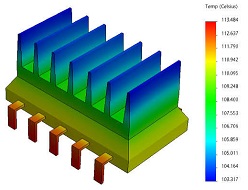
- Calculate temperature distribution.
- Determine heat flow and heat-transfer rates.
- Identify overheating and thermal hotspots.
- Evaluate cooling-system performance.
- Predict thermal expansion and temperature-related damage.
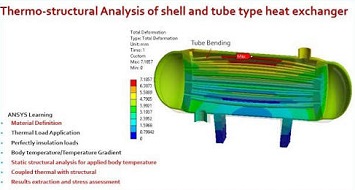
3. Coupled Structural–Thermal Analysis:
This combines structural and thermal calculations to understand how temperature
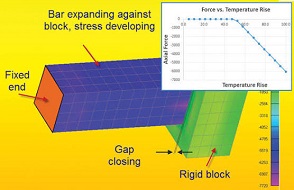
affects mechanical performance. For example, when a metal component heats up,
it expands. If its expansion is restricted, thermal stresses develop.
This assumes linear elasticity, uniform temperature, and ideal restraint. Actual
stresses depend on geometry, boundary conditions, and material properties.
Example: A turbine component experiences high temperatures and centrifugal
forces. Thermal analysis predicts its temperature field, while structural analysis
evaluates stress and deformation. The combined analysis helps engineers
assess whether the component can operate safely.
4. Engineering software used: ANSYS Mechanical:
Structural stress, deformation, heat transfer, modal analysis, and coupled-field simulations.
Abaqus: Nonlinear structural behavior, contact, material plasticity, and thermal-stress problems.
COMSOL Multiphysics: Coupled physics, heat transfer, solid mechanics, and multiphysics modeling.
SOLIDWORKS Simulation: CAD-integrated structural and thermal studies for product development.
5. Typical analysis workflow:
1. Create the geometry:
Build or import the CAD model.
2. Define material properties: Elastic modulus, conductivity, density, expansion coefficient, etc.
3. Apply loads and boundary conditions.
Forces, pressure, temperature, heat flux, supports, and convection.
4. Generate the finite element mesh: Divide the model into computational elements.
5. Solve and validate.
Wishing you all the best,
http://www.seeyourneeds.in