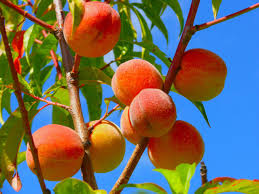
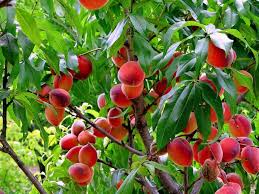
Peach Farming: The scientific name of the Peach is Prunus persica.
Apart from the garden fresh consumption, the Peach is an important fruit in the food processing industry.
High-quality Peach has adequate demand in both the domestic and international market. Peach is an important
fruit crop of Meghalaya. it is also grown in almost all states of the NEH region because of introduction
of the low chilling varieties. Fruits are rich in protein, sugar, minerals and vitamins. It has various uses
as fresh fruit as well as processed product.
Soil and climate: It is cultivated on varied type of soils but deep
sandy loam soil rich in organic matter is best. It is highly susceptible to water logging and prefer perfect drainage.
It can be fitted in any type of farming system and can thrive well in high hills, foothills as well as mid-hills situations.
Varieties: Low chilling varieties like TA-170, Flordasun, Shan-e- Punjab and Sharbati are suitable for NEH region. Propagation: For raising root stock, wild Peach is propagated through seeds.
Seeds are kept in moist sand for about 10-12 weeks for stratification. The germination and vigour of the seedling
can be improved by pre-sowing treatment of seeds with thiourea (5g/l water), GA3 (200mg/l water) or IBA (100 mg/l water).
The seeds are sown in beds about 5 cm deep and 15 cm apart at a row to row spacing of 20 cm in the month
of October-November. Beds are mulched with dry grass followed by light irrigation.
Grafting: Tongue grafting in the month of November is commercial method of multiplication.
A smooth slanting cut of 4-5 cm is made on the one year old rootstock at about 15-20 cm above the ground level and another
downward cut is given starting approximately 2/3rd from the top of the slanting cut and about 2 cm in length.
This formed a tongue like structure on the stock.
Intercropping: Income can be obtained by growing intercrops such as ginger, chilli,
French bean, rice bean, urd bean and vegetable crops in the under storey of Peach during pre-bearing stage.
Preparation of land and pits: Contour lines are marked and half moon terraces (1m.dia.) are prepared.
Pits (size 0.75 x 0.75 x 0.75 m) are dug at 5 x 5 m apart on half moon terraces and refilled about 10 cm above
the ground level with upper 30 cm soil along with 15-20 kg FYM, 100g Urea, 100g MOP, 300g SSP and 30g chlorpyriphos.
Planting: The best time for Peach planting is June to August. If there is no rain
after transplanting, light irrigation is given. Peach can also be planted during Dec.-Jan., if irrigation facility is available.
Training and pruning: Peaches are usually trained to an open-centre system.
Cut back newly planted trees to about 30 inches high, just above a lateral branch; select 3-4 laterals with wide-angle crotches spaced evenly.
Diseases and Pests: Peach is less affected by diseases and pests. However, sometimes,
powdery mildew and shot hole cause damage to the crop. Powdery mildew disease cause white powdery substances on the leaves,
buds and flowers. This disease is controlled by spraying Sulfex @ 2.5g/l of water.
Harvesting and yield: For distant market, fruits are harvested when they attain
good colour with hard skin, whereas, for local consumption, ripe Peaches are harvested by twisting with hand. The
peak harvesting period of Peach is last week of April to May. On an average, 20-30 kg fruit/tree can be
harvested from 3 years old tree.
Wishing you all the best,
http://www.seeyourneeds.in